
By: Bill Watson / 5-18-26
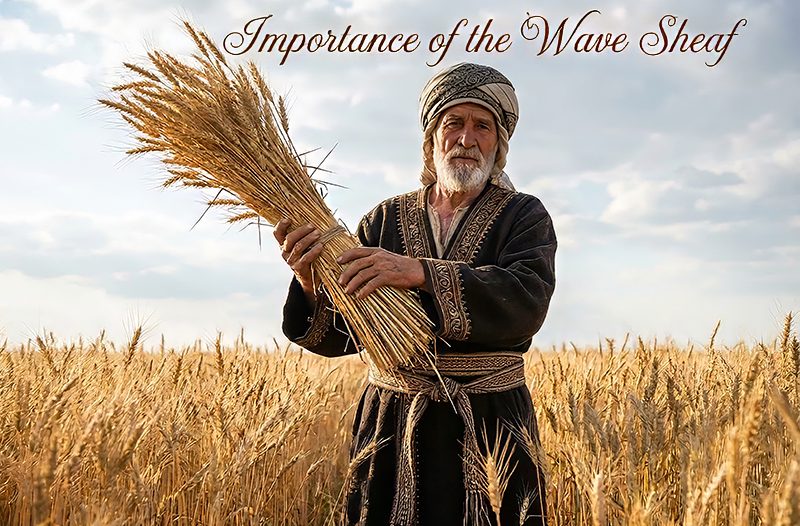
It is commonly known within God’s Church that the waiving of the sheaf of firstfruits before the Lord on “the morrow after the Sabbath” (Lev 23:9-11) was a portrayal of Christ presenting Himself to His Father following His resurrection (John 20:17). This connection to Jesus Christ’s resurrection should erase any questions about which Sabbath Leviticus 23:11 is referencing. Christ fulfilled this ritual’s portrayal of first fruits because He is the “first of the first fruits” (1 Cor. 15:23).
Interestingly, this “Wave-Sheaf Day” continued to be observed forty days after what “traditional” Christians believe to be Easter Sunday. However, the celebration came to be known as “The Feast of Ascension.” It developed into a cherished feast and was promoted by many early Catholic (Universal Church) fathers. It grew to become a significant spiritual, devotional, and historical tradition. Its traditional value has remained so important to this day that even some Protestant denominations have retained its observance as part of their liturgical celebration.
[Ref: The Catholic Voice]
It is believed by some that the idea of a “Wave Sheaf Day” later contributed to the adoption of Sunday, the “first day of the week,” in the New Testament for weekly observance, replacing the 7th-day Sabbath.
THE ACTUAL WAVE SHEAF FULFILLMENT
The original description of the Wave Sheaf in Leviticus 23:10-15, which identifies fifty days after the “morrow of the Sabbath” (:11) is somewhat ambiguous and unclear. But knowing this ritual points to the actual Lamb of God, Jesus Christ, this eliminates questions surrounding which Sabbath. This ritual, which was nothing more than a shadow of the reality to come, is critical to the formula in determining when Pentecost should be observed. And Pentecost is significant because it validates both the resurrection of Jesus Christ, and by extension, the supernatural “method” of harvest God the Father is using to convert human beings to spirit–– the RESURRECTION!
Let’s note that following the resurrection of Jesus, early in the morning, while it was yet dark on the first day of the week (John 20:1), an unusual and significant event occurred: Jesus appeared to Mary Magdalene. She supposes Him to be the gardener, but after addressing her by name in that familiar voice she recognized, she reaches out to embrace him. However, Jesus resists and says, “Do not cling to Me, for I have not yet “ascended” to My Father; but go to My brethren and say to them, ‘I am “ascending” to My Father and your Father, and to My God and your God’ ” (John 20:17). Interestingly, later that same day, Jesus met His disciples saying, ‘Rejoice!’ And they came and held Him by the feet and worshiped Him” (Matthew 28:9 & John 20:19).
But something happened between the morning He saw Mary in the garden and the time He appeared in the room with His disciples later that same day. This was apparent because He was now okay with His disciples holding onto him (Matt. 28:9). Clearly, since He was the fulfillment of the Wave Sheaf, obviously in the interval, He ascended to His Father as He said. This fulfilled the unique ceremony identified in the Old Testament as the Wave-Sheaf Offering.
This is why we find the term “first-fruits” is used to describe the resurrected Christ! Notice: “But now Christ is risen from the dead, and has become the FIRST-FRUITS of those who have fallen asleep [died]. For since by man came death, by man came also the resurrection of the dead. For as in Adam all die, even so in Christ shall all be made alive. But every man in his own order: Christ the first fruits; AFTERWARD they that are Christ’s [Christians] at his coming.” (1 Cor. 15:20-23).
These texts illustrate Christ’s ascension to His Father on the morning following His resurrection late on Sabbath afternoon, and refers to Christ presenting Himself to His Father as the first-fruits from the dead on Sunday, the first day of the week (John 20:17). This connects with the pattern of the waving of the sheaf of first-fruits before the Lord by the priest on the “morrow after the Sabbath” (Lev. 23: 10-11).
This fulfillment of the OLD TESTAMENT wave sheaf ceremony in the New Testament confirms that “the morrow after the Sabbath” in the Old Testament connects with “the first day of the week” in the New Testament. It also shows that, in the New Testament, “the first day of the week,” following the weekly Sabbath DURING the Days of Unleavened Bread, is the “Wave Sheaf Day” for those Christians who recognize this Biblical truth. Keep in mind that the New Testament is clear that the first day of the week is Sunday because the Days of Unleavened Bread commenced on Thursday, after Christ was crucified on Wednesday.
CONTINUING PROOF OF THE COUNT TO PENTECOST
There are seven New Testament texts that mention the first day of the week, all of which are clearly connected to the Days of Unleavened Bread. They are Matthew 28:1, Mark 16:2, Mark 16:9, Luke 6:1, Luke 24:1, John 20:1 John 20:19,
These six texts appear at the time of the death, burial, and resurrection of Christ in Matthew 28:1, Mark 16:2, Mark 16:9, Luke 24:1, John 20:1, and John 20:19. Unquestionably, we know from these six scriptures that they occur during the seven-day Feast of Unleavened Bread.
The season of the crucifixion of Christ is plainly stated: “Now the Feast of Unleavened Bread drew near, which is called Passover. And the chief priests and the scribes sought how they might kill Him” (Luke 22:1-2).
So, we see “the first day of the week” mentioned in Matthew 28:1, Mark 16:2, Mark 16:9, Luke 24:1, John 20:1 John 20:19 all occurred during the Days of Unleavened Bread because we absolutely know Christ was killed on Nisan 14, the day of Passover, which immediately precedes, and is connected to the Days of Unleavened Bread, commencing on the 15th of Nisan (Lev. 23:5-6).
So interestingly enough, because we know Christ was crucified on a Wednesday, and was in the tomb for three days and three full nights, it appears to be very plain that Christ ascended to the Father on that Sunday morning as the fulfillment of this wave sheaf; as was originally established in the sacrificial system, representing the harvest of first-fruits.
We should note that “the first day of the week” occurred annually, not weekly, in this context. Leviticus 23 essentially says the same thing when it mentions “the morrow after the Sabbath.” That does not mean weekly; it simply means annually when that time of the year occurs. But sadly, because Christians today do not observe the biblical feasts, they misunderstand the term “first day of the week” in the New Testament. This misinterpretation leads many traditional Christians to believe it is a weekly observance of Sunday, replacing the seventh-day Sabbath, which is the fourth commandment! And this is very unfortunate!
Consider this interesting event. Paul is involved in a “collection” of goods for some brethren in need and recommends that it be completed by the first day of the week. This way, there will be no gatherings on that day, which would otherwise delay the distribution of those goods. Paul wanted it completed by the time he arrived. And why would this be important to him? Because: “…I will stay on at Ephesus until Pentecost” (1 Cor. 16:8).
Now most won’t make this specific link to this charitable collection, but as surprising as this might be for some, this too is an indirect reference, but a direct connection to the Days of Unleavened Bread–– and you may ask, how can that be? Simply, because the count to Pentecost begins during the Days of Unleavened Bread and, amazingly, in particular, commences from Wave Sheaf Sunday as day number one, ending on the 50th day, which is Pentecost Sunday!
So, how is that significant, you might ask? Obviously, the narrative Paul describes occurred during the 50-day period following the Days of Unleavened Bread. And he was telling everyone he would stay in Ephesus until Pentecost. So, it could be just another plausible reason why Sunday was selected for this collection of gifts to be taken to Jerusalem. But clearly had nothing to do with changing the weekly Sabbath!
As has been illustrated, the Old Testament observance of the Wave Sheaf Day Offering on the “morrow after the Sabbath,” portrays Christ, the first-fruits, to His Father on the “the first day of the week”.
In John 20, John describes an early morning meeting on the first day of the week between Christ and Mary Magdalene. It occurs by the empty tomb. After they talked, He sent her to announce His resurrection to the disciples. In the evening of that same day, all the disciples, except Thomas, were gathered together (John 20:19 -23). Now the Bible describes, “they were gathered for fear of the Jews.” Uniquely enough, this worked to Christ’s advantage: under normal circumstances, the disciples would be at the temple for the Wave Sheaf ceremony, but they weren’t because of their fear of the Jews.
Their gathering afforded Jesus, the real Wave Sheaf Offering, to appear among them. Notice, “Jesus came and stood among them, showed them his hands and side, rejoiced with them, forgave them, and breathed the Holy Spirit upon them as a symbol of something yet to come (John 20:19 -23). This experience of His visitation, validating His success, reminded them that the Wave Sheaf Day is to celebrate and rejoice in the resurrection of Christ, which has now paved the way for mankind to access immortality. In other words, the Father’s objective of reproducing Himself was now complete, and the process was now in place!
When we think about it, this was a major accomplishment, and celebrating the resurrection of Christ has been somewhat marginalized in our Spring Festival observance. Perhaps, it would do us well as we commemorate His death on Passover night, to take some time and consider the affirmation that comes with the Wave Sheaf Day to be assured the resurrection of Christ, the first of the first-fruits, has now paved the way for the rest of us (1 Cor. 15:23).
After all, the resurrection of Christ is the “linchpin” of the Christian faith, and the event upon which Christian doctrine stands or falls. Buddha is dead, Muhammad is dead, Confucius is dead, Joseph Smith is dead, even Moses is dead, but CHRIST IS ALIVE! The apostle Paul says, “But if there is no resurrection of the dead, then not even Christ has been raised. And if Christ has not been raised, then our preaching is futile and your faith is empty. … For if only in this life we have hope in Christ, we should be pitied more than anyone” (1 Corinthians 15:13-14, 19).
THE WAVE SHEAF IS KEY TO PENTECOST
Interestingly enough, Wave Sheaf Day in the New Testament marks the beginning of the seven-week or fifty-day count to Pentecost. This is within the pattern described in Leviticus 23:15-16 when it says “the morrow after the Sabbath.”
An example of counting the Sabbaths is found in Luke 6:1(KJV), “And it came to pass on the second Sabbath after the first, that he went through the corn fields; and his disciples plucked the ears of corn, and did eat, rubbing them in their hands.”
This verse makes no sense without understanding the instructions in Leviticus 23 for counting the seven weeks to Pentecost. The word “first” here is a short expression for the first Sabbath during the Days of Unleavened Bread, the week before, and Luke 6:1 describes the second weekly Sabbath of the 7-week count to Pentecost.
Also, the reference to cornfields and picking ears of corn indicates that this event took place during the early spring harvest. This also illustrates it is evident the 50 days were still being counted, as was the term Sunday when Thomas met Jesus (John 20:26). Notice the term “after eight days.” Curiously, he did not refer to that Sunday as “the first day of the week.” But rather, refers to it as “day eight!” Why do you think that is? Because it was proving that counting to 50 days was being observed according to the instructions in Leviticus 23, as was the Wave Sheaf, understanding that it pointed to Christ!
The “Wave Sheaf Day” or “the morrow after the Sabbath” in Leviticus 23 became “the first day of the week” in the New Testament. The Christians of the New Testament continued to believe this understanding and recognized it for many years after Christ ascended into Heaven, setting an example for God’s people.
The purpose of the Wave Sheaf Day in the New Testament is to celebrate and rejoice in the resurrection of Christ. The resurrection of Christ is the linchpin of the Christian faith, and the event upon which Christian doctrine stands or falls. The Wave Sheaf Day is a distinct day for recognition and emphasis. Would it be wrong for the people of God to take time to consider this priceless benefit, recognizing and emphasizing the resurrection of Christ on the day of the Wave Sheaf! It certainly wouldn’t do us any harm to take the time to recognize the resurrection of Christ, which allows us to identify and observe Pentecost, and also points to the resurrection as a type of first fruits for the “born again” immortals into God’s kingdom!! (Jas. 1:18, Eph. 1:12, Rev. 14:4)

