Life, Death, and Fruit Flies

by Mike James

I read an interesting fruit fly study that got me thinking about how stress may impact humans. The study was conducted by Christi Gendron, a neurobiologist at the University of Michigan.

Gendron conducted a study on how living fruit flies respond to the sight of dead fruit flies. The research was published in the journal PLOS Biology. Apparently, neurons in the flies’ brains make them age faster after seeing dead flies. Scientists believe this relates to perceptions within the brains of animals causing physical reactions in their bodies.

Dr. Gendron and Scott Pletcher, who is a biologist at the University of Michigan, discovered how flies deal with death unintentionally. They were trying to see whether flies would show a behavioral or physiological response, like a heightened immune system, after being around other flies that had been made sick with a disease. “The only types of responses we saw happened after the flies that we infected died,” Dr. Pletcher said.

Continue reading


Biblical Discrepancies – Esau’s Wives

by Mike James

How many wives did Esau have? This is yet another seeming discrepancy in the Bible. A closer look and research will reveal the Bible is not creating a discrepancy.

First, let’s look at the scriptures that address the various wives of Esau.

Genesis 26:34: And Esau was forty years old when he took to wife Judith, the daughter of Beeri the Hittite, and Bashemath, the daughter of Elon the Hittite (KJV).

Genesis 28:9: Then went Esau unto Ishmael, and took unto the wives which he had Mahalath the daughter of Ishmael Abraham’s son, the sister of Nebajoth, to be his wife (KJV).

Genesis 36:2-3: Esau took his wives of the daughters of Canaan; Adah the daughter of Elon the Hittite, and Aholibamah the daughter of Anah the daughter of Zibeon the Hivite; And Bashemath Ishmael’s daughter, sister of Nebajoth (KJV).

Continue reading

Another Alleged Bible Discrepancy

Did the Edomites refuse supplies to Israel when they passed through their land, or did they furnish them? This apparent discrepancy revolves around two scriptures provided below:

Numbers 20:19-20: “And the children of Israel said unto him, We will go by the high way: and if I and my cattle drink of thy water, then I will pay for it: I will only, without doing any thing else, go through on my feet. And he said, Thou shalt not go through. And Edom came out against him with much people, and with a strong hand” (KJV).

Deuteronomy 2:28-29: “You will sell me food for money so that I may eat, and give me water for money so that I may drink, only let me pass through on foot, just as the sons of Esau who live in Seir and the Moabites who live in Ar did for me, until I cross over the Jordan into the land which the Lord our God is giving to us” (KJV).

Continue reading

ENOCH: IS IT SCRIPTURAL?

By: Bill Watson

Church of God Independent Ministries

There is a lot of “chatter” on the Internet these days about the Book of Enoch. Many influencers, podcasters, authors, and commentators, as well as some religious authorities, reference the Book of Enoch as a credible source to support an eschatological narrative that discusses certain watchers [a.k.a. angels] God allegedly sent to help, guide, and advise mankind, but instead, corrupted them.

There is a lingering interest and credibility associated with this book for several reasons. First, in the book of Jude, we see this apostle referencing the writings of Enoch and claiming it mentions the return of Jesus Christ (Jude :14). We also have evidence from early church history that some of the early “orthodox” church fathers used the book as a reference. However, by the 5th century, its influence was marginalized because it wasn’t canonized.

Continue reading

Bible Discrepancies – Spying Canaan

by Mike James

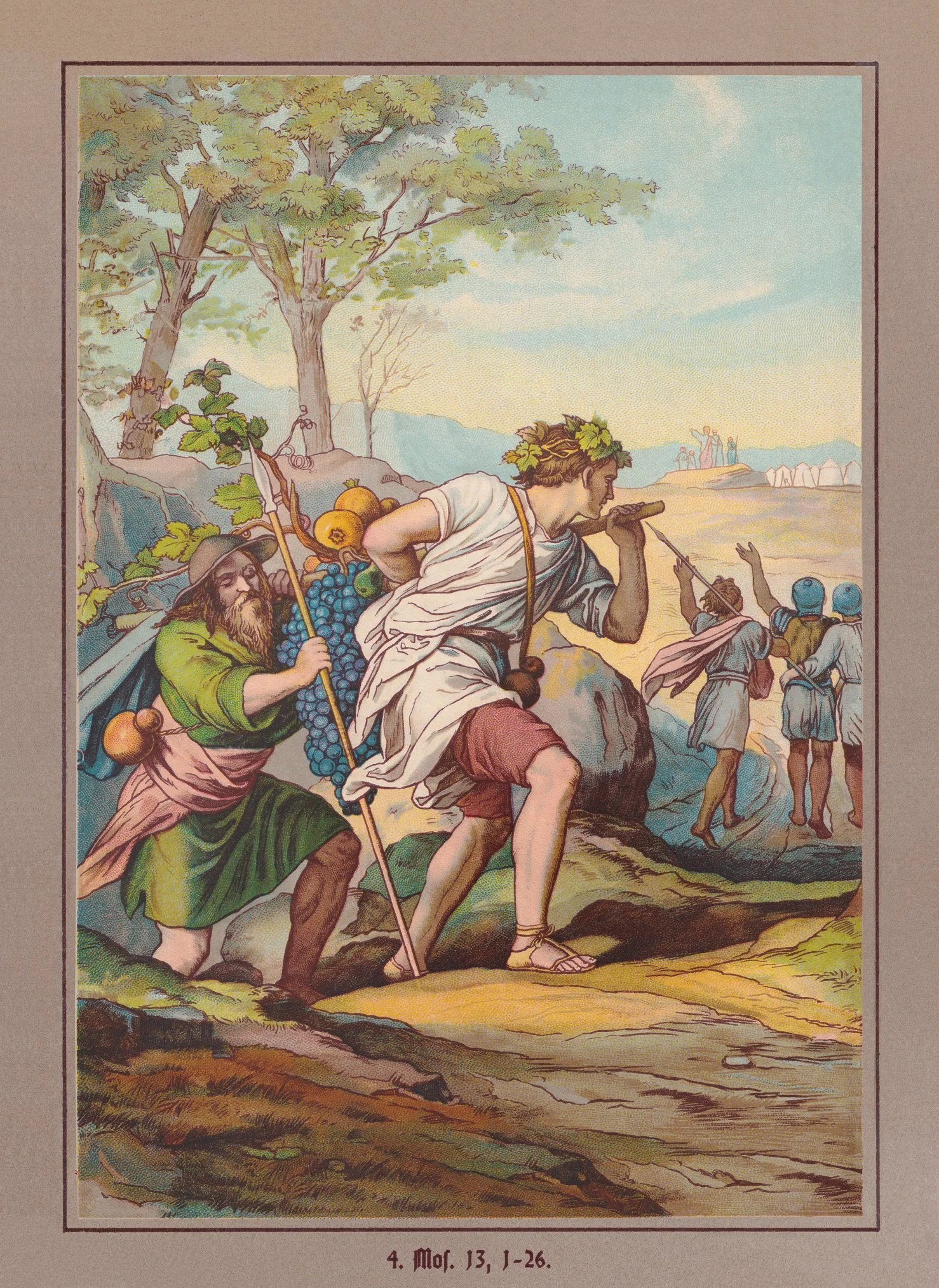
Was it God’s idea to spy out the land of Canaan or the people’s? This alleged discrepancy relates to the two scriptures provided below:

Report of the Spies (Numbers 13, 1 – 26). Chromolithograph after a drawing (1860) by Julius Schnorr von Carolsfeld (German painter, 1794 – 1872), published ca. 1880

Numbers 13:1-2: And the Lord spake unto Moses, saying, send thou men, that they may search the land of Canaan, which I give unto the children of Israel: of every tribe of their fathers shall ye send a man, every one a ruler among them (KJV).

Deuteronomy 1:21-23: Behold, the Lord thy God hath set the land before thee: go up and possess it, as the Lord God of thy fathers hath said unto thee; fear not, neither be discouraged. And ye came near unto me every one of you, and said, We will send men before us, and they shall search us out the land, and bring us word again by what way we must go up, and into what cities we shall come. And the saying pleased me well: and I took twelve men of you, one of a tribe (KJV).

Continue reading

HOW OLD IS THE EARTH & UNIVERSE?

By: Bill Watson

Church of God Independent Ministries

In today’s Christian community, there is a controversy over the age of the earth. There is a segment of Christians who firmly believe that the earth and universe are only 6000 years old, while another group believes it could be billions of years old, as evolutionists would have you think. Frankly, this is one of the compelling and underscoring reasons the young-earth Christians support a young-earth hypothesis–to differentiate themselves from evolution. But do we have to go to such an extreme to counter the theory of evolution and “cross swords” with science?

Does the Bible have anything to say about this? Does the Bible address this question? Can we answer this by using scripture? Or is this one of those questions that cannot be answered except by theorizing or hypothesizing about what the answer MIGHT or COULD be?

Continue reading

Questions About Tongues

By: Mike James

In Acts 2, we have the first example of the gift of tongues occurring. The Holy Spirit caused this miracle to occur (Acts 2:4), and the miracle was the ability to speak in foreign languages and to be understood by speakers of that language (Acts 2:5-12).

Later in 1 Corinthians 12:10, we read that some will have the gift of speaking in tongues (diverse languages) and others will have the gift of interpreting those languages. The same Greek word here, glossa, is used in Acts 2, where it was clear we are speaking about foreign languages.

Continue reading

Books Mentioned in the Bible

By: Mike James

by Mike James

Whenever you get into a discussion about whether apocryphal or pseudepigraphal books should be in the Bible, some will mention books mentioned in the Bible. The question will be why these books in the Bible aren’t part of the canon if the Bible itself mentions them. Let me provide a few examples of what I’m talking about.

In Numbers 24:14, we read the following: “Wherefore it is said in the book of the wars of the Lord, What he did in the Red sea, and in the brooks of Arnon.”

Continue reading